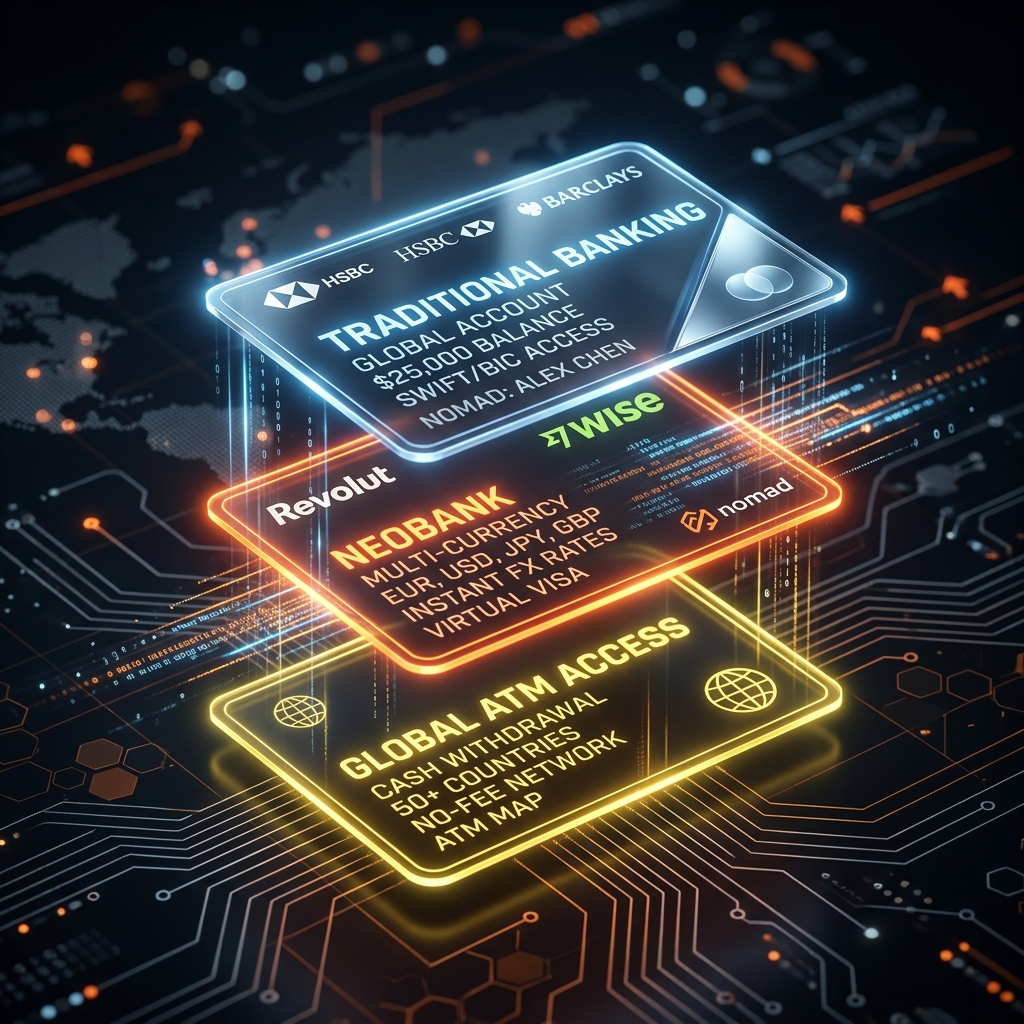
Executive Summary: Reddit communities like r/digitalnomad are currently filled with "account freeze" horror stories. In 2026, the combination of AI surveillance and the "Address Crisis" means that a single-bank strategy is no longer viable. We present the definitive 3-layer financial stack to ensure your capital remains accessible anywhere in the world.
The End of the Single-Bank Strategy: Financial Anti-Fragility in 2026
In the early 2020s, a digital nomad could comfortably navigate the world with nothing more than a Revolut or Wise account. It was the "Golden Age of Neobanking," where KYC (Know Your Customer) requirements were lax and the concept of a "residential address" was a mere formality. In 2026, that era is officially over. We have entered the age of Digital Financial Surveillance.
As documented extensively in the 2026 threads of r/digitalnomad and r/expat, the "Single-Bank Strategy" is no longer just a convenience—it is a single point of failure. Banks, both traditional and digital, have integrated sophisticated AI-driven location tracking and compliance algorithms. These systems are designed to detect "nomadic patterns" that mimic money laundering behaviors, leading to sudden, non-negotiable account freezes that can leave you stranded without liquidity in a foreign jurisdiction.
The goal for 2026 is not just to have a bank account, but to build a distributed financial stack that is resilient to AI flagging, jurisdictional shifts, and the "Address Crisis."
The "Address Crisis" Explained: The AI-Powered Panopticon
The most common cause of account termination in 2026 is the "Address Crisis." For decades, nomads used "Virtual Mailboxes" to satisfy residency requirements. However, banking regulators have caught up. Most "Address Crisis" closures are now triggered by three high-tech factors:
- CMRA Detection: Financial institutions now subscribe to massive, real-time databases of Commercial Mail Receiving Agencies (CMRA). When you input an address, an API instantly checks its USPS (or local equivalent) coding. If it’s coded as a business/mail provider rather than a residential dwelling, the system flags the account for "Residency Verification."
- Geolocation Mismatch: In 2026, banks don't just look at where you say you live; they look at where your app "pings." Consistent logins from Bali or Medellín when your address is supposedly in London or Austin trigger Impossible Travel flags. If your metadata shows you haven't been in your "home" country for 180+ days, AI-driven compliance engines automatically downgrade your risk profile.
- Regulated Jurisdictions: Major hubs (the US under the evolved Patriot Act and the EU under AMLD7) are enforcing stricter "Physical Presence" rules. Banks are now legally liable for confirming that customers actually reside within the jurisdiction they claim.
Layer 1: The Traditional Anchor – Your Institutional Foundation
The first layer of a resilient 2026 stack is the Traditional Anchor. This must be a branch-based, "brick-and-mortar" bank in a stable, high-reputation jurisdiction (your home country or a top-tier expat hub). The Anchor is not for your daily coffee—it is for continuity.
Why the Anchor is Non-Negotiable
Institutional credibility is the currency of the 2020s. When a Neobank asks you for a "Source of Wealth" or a "Reference Letter," a statement from a 150-year-old bank like HSBC, Chase, or a Swiss private bank carries weight that a Wise statement does not. The Anchor acts as the ultimate "safe harbor" for your primary reserves.
Recommended Jurisdictions for 2026 Anchors:
- The United States (For Non-Residents): Despite the reporting requirements, a US bank account (e.g., Chase or BofA) is a powerful anchor due to the liquidity of the USD and the depth of the US financial system.
- Switzerland (The Fortress): Banks like CIM Bank or Swissquote offer a neutral, high-security environment for those with $100k+ in assets. They are accustomed to international clients and are less likely to "panic-freeze" accounts based on travel patterns.
- Isle of Man / Jersey (Expat Hubs): Specifically designed for those living outside their home country, these offshore hubs provide the stability of UK law without the residency requirements of the mainland.
Layer 2: The Operational Neobanks – Your High-Frequency Drivers
The "Ops" layer consists of the neobanks you use for daily life: receiving salary, paying bills, and currency exchange. In 2026, the rule is N+1. If you need one neobank, you must have two. If you need two, you must have three.
The 2026 Operations Leaders
| Provider | Jurisdiction | Key Strength | Nomad Risk |
|---|---|---|---|
| Wise | Global / UK | Best FX rates; transparency | High CMRA sensitivity |
| Revolut | Lithuania / UK | Best lifestyle features & multi-currency | Strict AML "Source of Funds" audits |
| Mercury | US | Best for Nomad Business (LLCs) | US-centric compliance only |
In 2026, the strategy is Isolation of Assets. Never keep more than 2-3 months of living expenses in Layer 2. Neobanks are notorious for "automated freezes" where a human might not look at your case for 30 days. By splitting your operational capital between Revolut and Wise, you ensure that a freeze at one doesn't leave you unable to pay rent.
Layer 3: The ATM Cashier – Liquidity in the Physical World
Layer 3 is about the "Last Mile"—the ability to pull physical cash out of an ATM in a remote village without paying 10% in fees. While the world is increasingly cashless, the global nomad often operates in "Cash-Cultures" (Southeast Asia, Latin America, parts of Southern Europe).
The "Holy Grail" Cards of 2026
The **Charles Schwab High Yield Investor Checking** and **Fidelity Cash Management** accounts remain the undisputed champions. Their value proposition in 2026 is simple:
- Unlimited ATM Fee Rebates: If a Thai ATM charges you $7, Schwab pays it back. At the end of a nomadic year, this can save you $500–$1,000.
- No Foreign Transaction Fees: They use the pure Visa/Mastercard exchange rate with zero markup.
Warning: These accounts are increasingly difficult to open for those without a US social security number or a verifiable US residential address. For non-US nomads, HSBC Expat or DBS Treasures are the closest global alternatives.
Combatting AI Surveillance: Technical Countermeasures
If you are living in a way that violates the "Geographic Expectations" of your bank, you must employ Digital Stealth. In 2026, simple VPNs are often blacklisted by bank servers. You need a more sophisticated approach.
1. The "Home Base" Server (Static IP)
Don't use a public VPN (like Nord or Express) for banking. These IPs are flagged as "proxy" traffic. Instead, set up a WireGuard server at a family member's home or use a dedicated **Residential Proxy**. This gives you a static, non-commercial IP address that appears as a standard home internet connection in your "Anchor" country.
2. Hardware-Based 2FA (The SMS Death Trap)
Relying on SMS for Two-Factor Authentication (2FA) is the leading cause of "Locked Account" syndrome for nomads. SIM cards fail, roaming is blocked, or phones are stolen. In 2026, you must transition to Passkeys or hardware keys like YubiKeys. These work offline and independent of any cellular network, ensuring you can always log in to your Anchor bank.
3. Metadata Hygiene
Banks now analyze device metadata (time zone, language settings, and Wi-Fi SSID lists). If you are banking on a phone set to "Bangkok Time" with a Thai SIM card, even a VPN won't hide your location. Maintain a dedicated "Banking Tablet" or "Banking Laptop" that stays synced to your home country's time zone and settings.
Technical Note on Virtual Mailboxes: The Residential Loophole
To survive a CMRA audit in 2026, you must distinguish between your Mailing Address and your Legal Residential Address.
Most banks allow you to have a separate mailing address. Use a family member’s or a friend’s "Residential Coded" home as your *Legal* address. Then, set your *Mailing* address to your Virtual Mailbox (CMRA). This satisfies the AI check while ensuring you still get your physical mail scanned and sent to you digitally. Never use a "Suite" number in a CMRA; try to find services that use "Unit" or "Apartment" designations, as these are less likely to trigger automated filters.
The 2026 Exit Strategy: Anticipating the Freeze
Even with a perfect stack, a freeze can happen. Your strategy must include a "Break Glass in Case of Emergency" protocol:
- The "Emergency $2k": Always keep $2,000 in a separate, "cold" account that you never use for daily transactions. This ensures you have flight money and 1 month of survival if your main stack is compromised.
- Crypto-Offramp: Maintain a verified account on a global exchange (like Kraken or Coinbase) and a self-custody wallet. In 2026, being able to liquidate Bitcoin into a local currency via P2P (Peer-to-Peer) markets is the ultimate nomadic insurance policy.
- Multiple Passports/IDs: If you have dual citizenship, link different bank layers to different IDs. This provides "Identity Redundancy."
Conclusion: Resilience is the New Wealth
The era of the "Lazy Nomad" is over. In 2026, financial sovereignty requires active management. By building a 3-layer stack—anchored in tradition, operated through digital-first neobanks, and fueled by global-liquidity cashiers—you create a financial fortress that moves with you.
Remember: a bank account is no longer a permanent fixture; it is a temporary tool. Treat your financial architecture like code—modular, redundant, and always ready for a migration. In an age of digital surveillance, distributed risk is the only way to safeguard your freedom.